Tutor guide · Algebra practice
How to use algebra practice
Learn equivalent steps, brackets and modelling with original linear-equation exercises, feedback and printable worksheets. Choose your language and curriculum separately.
For learners aged 14+ · free · no account required
What to do
Curriculum
Language, curriculum and teaching reference are independent choices. For learners aged 14+: selected linear-equation skills or review. Read the selected programme notes for its level, version and extensions. This is a limited original series, not a full course or an official examination paper.
Read the explanation
Read the explanation and worked examples first. Review the prerequisites, then start the ten-question practice set.
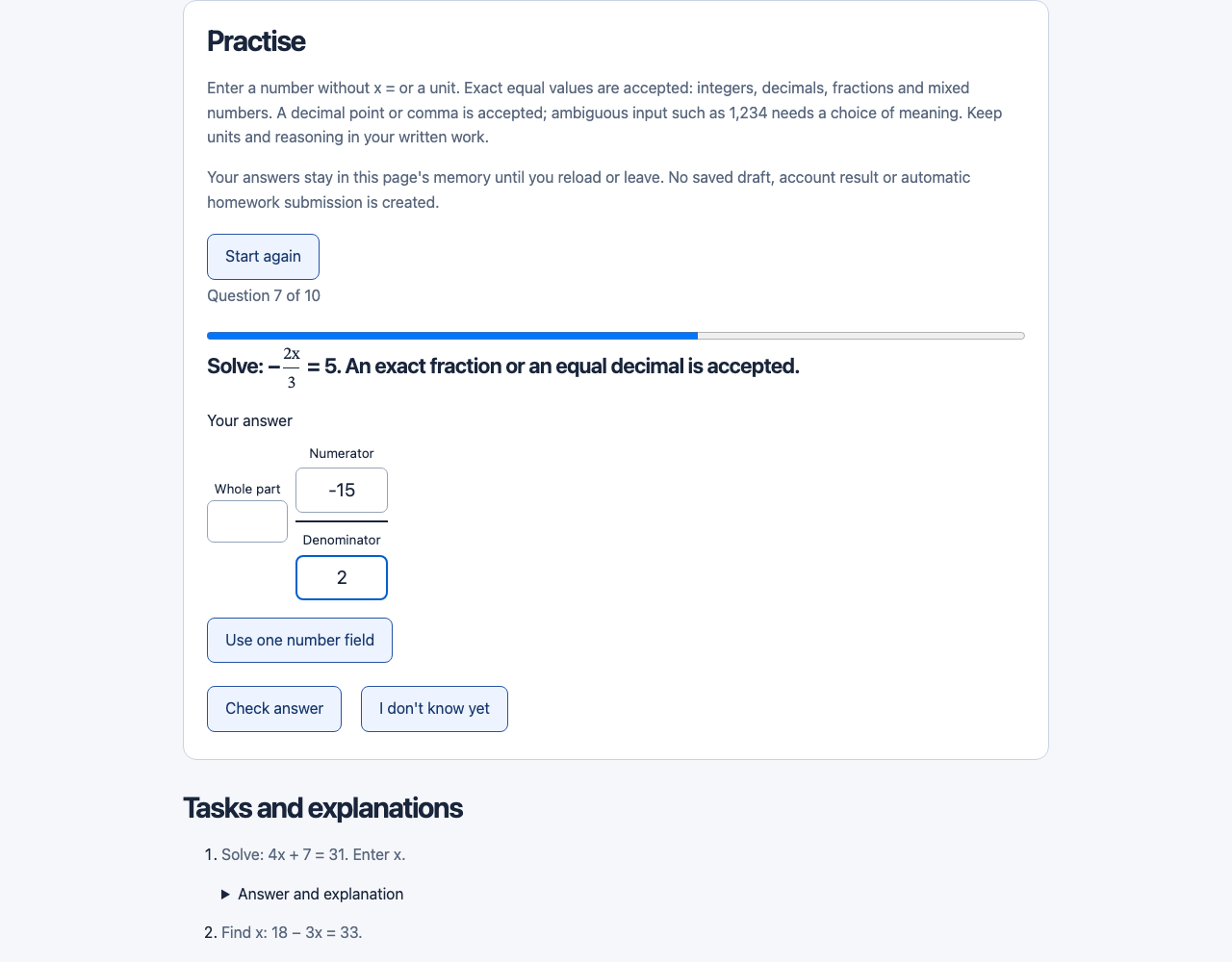
Your answer
Enter a number without x = or a unit. Exact equal values are accepted: integers, decimals, fractions and mixed numbers. A decimal point or comma is accepted; ambiguous input such as 1,234 needs a choice of meaning. Keep units and reasoning in your written work.
Check answer
Check each answer once. A valid attempt shows feedback and locks the answer; malformed input can be corrected without scoring. Move to the next question or skip it. Repeating missed questions does not replace your first result.
Explain your reasoning
The checker assesses a number or a selected option. It does not grade your reasoning, written equation or units. Use the rubric with your tutor or for self-checking. Ten tasks are a small practice set, not proof of mastery.
Print worksheet
Print the worksheet without answers, or select the separate answer key. In the browser print dialog choose Save as PDF. Upload the PDF through Materials and attach it to homework; this page does not submit homework automatically.
Good to know
- Your answers stay in this page's memory until you reload or leave. No saved draft, account result or automatic homework submission is created.
- The checker assesses a number or a selected option. It does not grade your reasoning, written equation or units. Use the rubric with your tutor or for self-checking. Ten tasks are a small practice set, not proof of mastery.
- Your curriculum, teaching reference and decimal mark stay selected when you change language or move between algebra topics and the catalogue. Copy the page link to share the same selections.
- The linked sections were consulted as a teaching reference. These explanations and tasks are original MomentDesk work. This is a topic cross-reference, not a complete textbook companion.
- Madrid 3.º ESO: modelling and interpreting quantities (D.2 / B.1). Criterion 2.1 includes checking the solution and suitable units. Only the number or option is checked automatically; review the model, steps, units and context with the rubric.
- France 3e, 2026–27: expanding, simplifying and solving first-degree equations. No/one/infinitely-many-solution classification is selected enrichment, not an explicit complete annual expectation. The new programme reaches 3e in 2028–29.
- NRW Gymnasium G9: review of selected year 7/8 skills. Practise brackets, simplifying expressions and solving linear equations; explain the remaining equality. The three solution cases are an original elaboration of the solution-set skill, not three explicitly listed regional requirements. The real-number domain extends the first-stage rational-number scope; the consulted school-plan example introduces real numbers in year 9 (UV9.2).
- Japan: review of selected first-year middle-school skills from the 2017 curriculum, fully introduced in 2021. Practise brackets, simplifying expressions and solving linear equations; explain the remaining equality. The no/one/infinitely-many-solution classification is original enrichment, not a first-year curriculum claim. The real-number domain is an extension beyond the rational-number setting of the first year, for this 14+ series.
- Korea: review of selected first-year middle-school skills from the 2022 curriculum, introduced for this year in March 2025. It reaches the third year only in March 2027. Practise brackets, simplifying expressions and solving linear equations; explain the remaining equality. The no/one/infinitely-many-solution classification is original enrichment, not a first-year curriculum claim. The real-number domain is an extension beyond the rational-number setting of the first year, for this 14+ series.
- Russia: mapping to the selected 2025 FRP edition, reviewing year 7 algebra. Practise brackets, simplifying expressions and solving linear equations; explain the remaining equality. The year 7 programme explicitly includes the number of roots of a linear equation. The real-number domain extends the year 7 scope with a concept introduced in year 8.
- CeDeC / INTEF is the August 2014 edition, used as a historical teaching reference. It is not a companion to the 2022 LOMLOE curriculum.
- Sésamath 3e, Magnard, June 2021: selected sections of the student workbook (ISBN 9782210115811). This cross-reference does not cover the whole workbook.
- QUA-LiS.NRW, 31 January 2020: a suggested school-plan example, especially UV7.6, page 34. It is a teaching reference, not a textbook or every school’s required sequence.
- MEXT, July 2017: official mathematics curriculum commentary, selected first-year sections on pages 70–74. It is a teaching reference, not a publisher textbook companion.
- Gyeonggi Office of Education, 10 March 2025: assessment guidance, mathematics chapter Ⅱ-1, pages 58–69. The criteria are a teaching reference; this checker does not assign its achievement levels.
- FIPI, Moscow 2026: selected guidance on computation, checking answers, written models and units. It is a year 9 teaching reference, not a textbook or a complete OGE preparation course.
- Tokyo Shoseki, 2025, 数学002-72: the publisher’s excerpts and teaching articles for pages 94, 96–97, 78, 101 and 104–108 were consulted. They connect equality-preserving operations, signs and coefficient transformations with modelling and checking the original situation. Classification into 0/1/infinitely many solutions and the real-number domain are MomentDesk extensions; this is a limited cross-reference, not the whole textbook. (Tokyo Shoseki · 東京書籍)
- Visang, Mathematics 1, first edition 1 March 2025, second printing 1 March 2026, ISBN 979-11-7316-034-9: pages 86–87, 89–91 and 92–93 were read in the publisher’s public e-book. They cover justified equation transformations, substitution, coefficients and a model checked against its situation and units. Classification into 0/1/infinitely many solutions and the real-number domain are MomentDesk extensions. Reasoning still needs manual assessment. (Visang · 비상교육)
- Cornelsen, Fundamente der Mathematik 7, NRW G9, first edition 2020, fifth printing 2026, ISBN 978-3-06-040177-2: the publisher’s open preview covers sections 6.2–6.6, pages 160–175. It explains justified transformations, special cases and modelling with units and interpretation. Its solution sets here use rational numbers; MomentDesk’s real-number domain is an extension. This limited reference keeps the original MomentDesk tasks and manual reasoning assessment.